Showing posts with label Baulis. Show all posts

01 July 2026

The “Heintzelman” Builder’s Labourers by Ann Tündern-Smith

We have noted several times already in this blog that there was a shortage of buildings, especially homes, for those returning from overseas after World War I, let alone newly arriving Displaced Persons. We suggested that this was due to the men who would’ve been building being otherwise engaged during the period of the War.

I’m reading Stuart McIntyre’s book on Australia’s Boldest Experiment, subtitled War and reconstruction in the 1940s. In it, Stuart pointed out that the housing situation before World War II already could have been described as a dire.

I’d rather quote Stuart than try to summarise his careful arguments and his supporting detail. Here we go, from pages 175–78.

“There was mounting concern during the later 1930s with conditions in the inner suburbs and the State governments of New South Wales, South Australia and Victoria all commissioned inquiries. All painted a grim picture of neglect and decay.

“The most substantial, the 1937 report of Victoria’s Housing Investigation and Slum Abolition Board, described ‘congested areas' of inner Melbourne with as many as 49 dwellings an acre crowded into narrow laneways, ‘blighted areas’ where terraces were cheek by jowl with noxious industries, and ‘decadent areas’ where larger houses that had fallen into disrepair were divided by plywood or hessian partitions into sub-lets.”

Little Oxford Street, Collingwood, Melbourne, beautifully photographed
by F. Oswald Barnett about 1935:  Note the tiny size of the nearest home
(Stuart Macintyre says that Barnett was the driving force behind the slum abolition
 movement in Melbourne)

[At a density of “49 dwellings an acre”, each dwelling occupied, on average, about 83 m² of land. However, on those inner-Melbourne laneways, many dwellings might have been tiny 19th century cottages or terraces built wall-to-wall, on very narrow allotments (sometimes only 3–5 metres wide), sharing laneways, yards, privies, and other facilities. Some cottages may have stood on only 40–70 m² of land, while the remainder was taken up by the lanes, tiny yards, and shared spaces. Modern housing developments would allow at least 10 times that amount of land for each home, including the garden separating it from its neighbours, although apartment blocks are different.]

“The (Victorian) Board’s external inspection of residences within an 8-kilometre radius of the city centre led to an internal examination of 6390 residences. It found that great majority had no kitchen, a third had no bathroom, and a quarter had neither gas nor electricity. They were disfigured by leaking roofs, unsound floors and defective drainage, poor ventilation, damp, and subject to rat and vermin infestation. Half were judged unfit for habitation without repair, the other half incapable of reclamation.

“New South Wales and South Australia reached similar conclusions and each created an authority with powers to remove slums and build affordable housing. These new dwellings had barely made a dent in the backlog when the onset of the Pacific War brought civilian construction to a standstill.

“… most (slum) residents would respond if removed from their blighted environment and decanted into new, improved accommodation under appropriate supervision. But this could not happen unless the government made good the failure of the housing industry. There was a shortage of houses because construction had come to halt during the Depression, and an insufficiency of rental accommodation at prices those on low incomes could afford. The solution lay in public housing built more efficiently to proper standards and let at subsidised rents.

“The Commonwealth used a variety of war controls on land sales, mortgage borrowing, building permits and materials to prevent house building and restrict renovations to minor repairs. Recruitment and manpower regulations attenuated the construction workforce: 28751 dwellings were built in 1941, just 3548 in 1942.

“By then the housing deficiency was estimated to be 150,000, and the tightening of rent controls in December 1941 added to the strain. It was most acute in the metropolitan areas and in country towns where munitions production was undertaken in vast new plants employing thousands of workers who swamped the rental market. A War Workers Housing Trust erected hostels and temporary ‘wartime cottages’ but many had to make do in sheds, garages, caravans and other makeshift accommodation.”

Another study directed by a University of Melbourne economist looked at the conditions in wartime housing. The investigators were mostly young women with Arts degrees who, between September 1941 and January 1943, interviewed one in 30 of all Melbourne households. They collected data on the dwelling, family structure, employment and income. They found that “that a quarter of the kitchens had no water supply and half lacked a hot-water service. Fewer than one in 10 had a refrigerator; about half used ice-chests and the remainder relied on daily purchases of perishables. The survey also revealed a marked disparity between the crowding and lack of amenities in suburbs such as Collingwood, where incomes were low and the overwhelming majority were tenants, and the more spacious homes across the Yarra in Hawthorn and Kew, where ownership was more common and facilities more advanced.”

The same economist then conducted a closer analysis of Melbourne’s “western suburbs, where the war had a marked effect. In addition to Williamstown’s naval dockyard and Newport’s railway workshop, the Sunshine Harvester agricultural implement works and a steel mill, tyre factory and various engineering works in Footscray, all working at full capacity, there were ordnance, ammunitions and explosives factories with more than 20,000 hands. The number employed in secondary industry grew from 23,000 in 1938-39 to over 53,000 in1941-42.

“Earnings also increased: the average household income was 9 pounds 5 shillings by the beginning of 1943 — but then a quarter of all households included relatives or boarders. Because of rent control, the average weekly cost of a four-room house in the area was low, just over 18 shillings — if you could find one vacant.

“These suburbs had not been included in the earlier Board inquiry and their housing stock differed from that of the inner suburbs: it consisted overwhelmingly of single-storey, detached residences, most of four or five rooms. While … only 5 per cent (were seen as) uninhabitable, a fifth had no sink or running water in the kitchen, half lacked a refrigerator or ice-chest, half again had no hot water in the bathroom and a tiny minority provided an internal toilet. With no possibility of remedying these deficiencies and a shortage of such basic materials as paint, most householders did what maintenance they could and saved for future improvements.”

Inner northern Melbourne was where our First Transport passengers were looking for accommodation as soon as they left employment where it was provided. We’ve looked at several who lived and worked in those western suburbs, which is why I’ve used a quote from Stuart Macintyre to describe the conditions that they still might have found in 1949 and into the early 1950s.

I have quoted from Stuart because I had not been factoring in the impact of the 1930s Depression on housing construction in Australia, nor Federal WWII controls on building activity, let alone realising the lack of amenities that we now take for granted in the housing that did exist.

I think that Stuart concentrated on studies of housing in Melbourne because that was where he lived and taught. He has noted already that the findings of the investigations were similar in Sydney and Adelaide.

Stuart was a professor of history at the University of Melbourne, who retired from that position in 2013 and died in 2021. One reason why I am reading his book on Australia’s Boldest Experiment is because Stuart and I were contemporaries at the University of Melbourne in our student days. I remember him well from our joint activities for the Amnesty International groups at that university. The other reason should be obvious to followers of this blog: it is about Australia in the 1940s, about the Australia into which our First Transport passengers found themselves entering in the hope of new lives.

It is quite possible that those living on Baltic farms before World War II lived in conditions similar to those described in 1937-1943 Melbourne, probably without running water, certainly without hot water services, without refrigeration and with external toilets. Since the DP camps often were in military barracks or similar communal accommodation, at least they might have had running water and internal toilets. But, reader, do not for one moment think that their initial accommodation after Bonegilla was roughly like you live today.

Another person in my life relevant to this story was George Kiddle. George was one of the 3-man team who interviewed the Displaced Persons who had heard, in September-October 1947, about the possibility of moving from post-War Germany to Australia. He also was the head, during 1978-81, of the Department of Immigration branch where I was working. Mind you, it was only on his last day at work that I realised that he was one of the 3 responsible for selecting my mother, and so responsible for my birth as an Australian.

I think it was George who told me something along the lines of building worker numbers in Australia being so short of what was required that anyone who had helped erect a shed on the family farm was a candidate for Australia.

The selection team did their best and succeeded in choosing 75 men who they regarded as suitable to work as Builder’s Labourers in Australia. Additionally, as noted in the case of Aleksander Nõmm, there were others with suitable experience who were described as Labourers instead.

At a guess, only 2 of the 75 were sent to work as Builder’s Labourers. Albinas Navickas and Jonas Strankauskas were allocated to the Department of Works and Housing, Woomera, SA, after a sawmill in Navickas’ case and fruit-picking plus casual labouring at Bonegilla for Strankauskas. We have been told elsewhere though that Albinas worked as a Linesman and Strankauskas was put onto joinery after initial labouring. The initial labouring just might have been supporting builders at Woomera.

I’m fairly sure that the 4 selected as Builder's Labourers but sent to brick-making companies were more likely to be employed in stacking bricks than building new houses from them. We know for sure that this was the case for 2 of the 5 sent to the Canberra Brickworks, but note that none of them were selected as Builder’s Labourers.

Mismatch? Yes! I think that what may have happened is that the Commonwealth Employment Service staff in the Bonegilla camp operated on a “first come, first served” basis in distributing the new arrivals to employers looking for labour, and the foresters, timber mills and brick manufacturers got in ahead of the builders.

Part of my purpose in running this blog is to look at the extent to which individuals were able to continue their careers in the context of what were then well known labour and staff shortages in various industries and occupations.

Right now, I can nominate only 3 Estonians, Nikolai Müristaja, Helgi Nirk and Ernst Kesa, and one Lithuanian, Kazimieras Balkauskas, as finding work in Australia which fitted well with their previous interests and training. Then there were some others, like Endrius Jankus, Albinas Kutka and Edvins Baulis, who trained in Australia and ran their own businesses. Most found an employer they liked and laboured for them – or went from employer to employer if they were less lucky.

MORE:

Australian Department of Home Affairs (2009) Oral History — George Kiddle https://www.google.com/search?client=firefox-b-d&channel=entpr&q=%22george+kiddle%22#fpstate=ive&vld=cid:7f244f7e,vid:RI1Y3qYqkN8,st:0, accessed 28 June 2026.

Faculty of Arts, University of Melbourne (2021) ‘Vale Professor Stuart Macintyre AO’ https://arts.unimelb.edu.au/news/past-news/vale-professor-stuart-macintyre-ao, accessed 27 June 2026.

Macintyre, Stuart (2015) Australia’s Boldest Experiment: War and reconstruction in the 1940s. Sydney, New South Publishing.

24 June 2021

Edvins Baulis (1916-1995): Builder of houses and communities, by Ann Tündern-Smith

Updated 1 March 2024.

Migrants can contribute to their new nations in many ways.  Edvins Baulis' speciality was the welfare of his fellow migrants and the community in general.  This made for a better Australia for all where he lived. 

Edvins in his early 60s
Photograph courtesy Erik Baulis

The Good Neighbour Councils (GNCs) started in 1949 and emerged as an Australian-wide movement in 1950, from a Citizenship Convention sponsored by the Commonwealth Government.  They united community groups and individual volunteers in assisting new arrivals to assimilate, to become like other Australians, the goal of settlement policy in those days.


As the work the GNCs was doing was valued by the Commonwealth Government, it supported them with funding.

In the 1960s, Australians and their governments started to think in terms of 'integration' rather than 'assimilation'.  This 'melting pot' approach aimed for an amalgam of the old and new, a new society rather than an expectation that only the migrants would change to fit into the old society (Lewins 2001).  It was in this environment that the Fraser Government decided to establish a Review of Post-arrival Programs and Services for Migrants in August 1977.

Known as the Galbally Review, its 1978 report acknowledged the good work the GNCs had done but found that their funding was now being used primarily for internal operations, such as liaison with other organisations and running conferences and seminars.  The money was not going towards direct services to migrants.

The Galbally Review advised that the money supporting the GNCs should be spent instead with ethnic organisations which were able to provide direct services to their own communities.  A two-year phase out of GNC funding was recommended (Galbally et al. 1978).  Around Australia, the GNCs folded, with only two exceptions:  one in Glenorchy and that in Launceston, led by Edvins Baulis.  As of 2021, only the Launceston Branch still operates (Winter 2006; Multicultural Council of Tasmania [2020]; E Baulis 2021) .

Known in Australia as Ted, Edvins led the Launceston GNC from that fateful year of 1978 until 1995, two months before he died.  As well, he was State President of the GNC during the periods 1982-85, 1987-90 and 1992-95.  In 1990, the GNC awarded him life membership (Anon n.d.; Winter 1993).

In a eulogy for Ted before Tasmania's Legislative Council, Independent Member for Launceston, Don Wing, said, 'Withdrawal of Federal funding ... following the Galbally Report caused him great anxiety and concern.  Good Neighbour Councils were abolished throughout Australia but survived in Tasmania and not only survived but actually flourished in the State mainly due to the commitment, leadership and persistence of Mr Baulis' (Wing 1995).

Ted's wife, Jean, was a Launceston local working in a bank, with several months experience of a refugee camp in Germany as a Girl Guide volunteer.  She kept up her interest in the refugees on her return to Launceston, enabling her to meet her husband-to-be at one of the Thursday evening meetings of the Launceston GNC he attended.

They married in October 1953 and had three sons.  After his death, she had the strength to finish up the remaining two months of his GNC presidency term (Examiner 1953; J. Baulis 2009).

Ted found the goodwill and energy to help start the Launceston Migrant Resource Centre while GNC president.  In general, Migrant Resource Centres around Australia now fulfil the roles previously carried out by the GNCs, but are led and resourced by post-WWII migrants from non-English-speaking nations and their descendents rather than by the Australian-born with generations of ancestry here.

Eulogies from Don Wing and the then Tasmanian Minister for Multicultural and Ethnic Affaris, Frank Madill, an undated curriculum vitae, and the recollections of his sons, particularly Erik, list Ted's many other community activities.

He was President of the Federation of Ethnic Communities Councils of Australia in northern Tasmania and President of the Latvian Community of Tasmania for ten years.

He organised an exhibition of Latvian arts and crafts to mark the 25th anniversary of the GNC in Tasmania.  It ran for two weeks in the Northern Regional Library, Launceston, in 1975.  He organised a similar exhibition for the State Library, Hobart, in September 1975.  During 1979, he was Vice-President of the Latvian Federation of Australia and New Zealand.

The Launceston branch of the GNC, under Ted's leadership, staged an International Concert at Launceston's Albert Hall on 4 October 1980.  It featured 70 dancers and singers from around the world, including the Wielangta Aboriginal Dance Group.  It attracted an attendance of four hundred.  Weeks later, on 21 November, he co-ordinated the mass choirs for Albert Hall's official opening by the State Governor.

Ted Baulis at the Latvian Arts Festival, Launceston, 1984
Courtesy Erik Baulis

He chaired the organising committee for the 34th Australian Latvian Arts Festival in Launceston in 1984, bringing many visitors to the region.  The week-long festival included singing and dancing performances as well as exhibitions of paintings by Latvian artists and traditional arts and crafts.  In 1990, the Latvian Community of Tasmania awarded him life membership.

Latvians parade in Launceston during the 1984 Latvian Cultural Festival:
Ted Baulis is on the right of the front row
Photograph courtesy Ervins Miezitis, from Latvians on Line Website

Part of a Hobart exhibition on multiculturalism in Hobart, early 1980s
Ted is the 'prominent migrant settler' from Latvia, second from left
Photograph courtesy of Jean Baulis

In 1987, he helped establish a weekly drop-in centre for migrants in Launceston.  It is still operated by the GNC in the Greek Community Hall and continues to bring together around 40 migrants every Friday morning.  The sessions conclude with a rousing rendition of We are Friends, which Ted composed for the Branch many years previously.

He was a member of the Launceston Male Choir for over twenty years and its President for 1975-78.  In 1988, Launceston's celebrations for Australia's Bicentennial included a performance by the Choir in the city's packed Albert Hall.  That year, it also sang in front of 10,000 at a Colonial Concert in the Royal Park, and at the Launceston Velodrome as part of the Anzac Day commemorations.

A quartet of singers from the Choir, the Tassietones, consisted of Ted, Robin Gregory, Alan Broughton and Merv Barnes, with Aileen Smith on piano.

Ted is on the far right of the back row
Courtesy Erik Baulis

He was on the executive committee of the St Giles Society, providing disability support for Tasmanians, during 1974-77 and worked for the Society for many more years.

He was a member of the State Government's Advisory Council on Multicultural Affairs and the Commonwealth's State Council of the Australian Broadcasting Commission (ABC) after being a member of the ABC's Program Advisory Committee for Northern Tasmania in the early 1980s.  He was a member of the Royal Commonwealth Society for many years and a councillor for 1976-78.  He was State President of St Paul's Latvian Evangelical Lutheran Church in Tasmania for 15 years, between 1974 and 1988.

In the second half of 1992, the Australian Government concluded a major cross-portfolio Evaluation of its Access and Equity Strategy's impact on all of its departments and agencies (OMA 1992).  Ted's contribution to this was acknowledged by a letter of thanks from the Government (E Baulis 2021).

After testing by the National Accreditation Authority for Translators and Interpreters, he was found fit to be an interpreter for the Latvian language.

He became the co-ordinator of a Multicultural Insight class at the Adult Education Institute's School for Seniors in Launceston.  He was a member of Launceston's Tasmania Day Committee.

Ted was President of the Master Builders' Association of Northern Tasmania for more than seven years and, in 1990, won the Master Builders' Ern Davey Award in recognition of his outstanding service and contribution to the building industry in Tasmania.

Ted (with two friends) building his first house in Bridgewater, 20 Km north of Hobart
Courtesy Erik Baulis

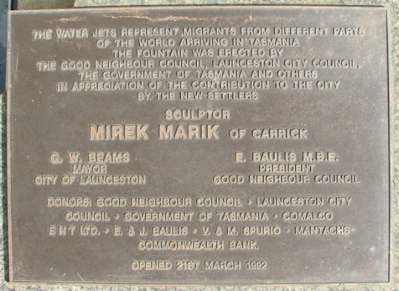
He instigated and organised the Multicultural Fountain in Launceston's Civic Square, to commemorate the contributions of migrants to Tasmania (Madill 1995).  It opened on 21 March 1992, preceded by many hurdles and some prolonged delays.  As such, it was a labour of love for Ted.  The fountain was created by a local Czech-born artist, Mirek Marik.  It has been relocated to parkland on the southeast side of the confluence of the Tamar and North Esk rivers (R Baulis 2021).

Launceston's Multicultural Fountain, relocated
Courtesy Ralph Baulis

Multicultural Fountain plaque
Photographer:  Ann Tündern-Smith

In addition to all of this community service, Ted and Jean also volunteered to help the Red Cross Meals on Wheels program.

Jean and Ted

It is not surprising that Queen Elizabeth made Ted a Member of the Most Excellent Order of the British Empire (MBE) in June 1979 (Wing 1995).

Jean and Ted
Courtesy Erik Baulis

According to the papers which record his selection for migration to Australia, Edvins was born in Piltene, in Kurzeme, Latvia, on 1 September 1916 (NAA: A11772, 33).  The province is known as Courland in English.  At the time of his birth, the area was caught up in widespread turmoil due to World War I.  His family lived on a small farm and endured meagre supplies, poor medical care and bitterly cold winters.  His eldest brother died of tuberculosis in the year he was born.  His father died of meningitis about 1919 (E Baulis 2021).

The Baulis family home in Piltene, Kurzeme, Latvia
Courtesy Erik Baulis

The selection papers for Australia say that Edvins had completed six years of primary school and two years of secondary school.  In 1938-39, he completed 15 months of compulsory military service in Latvia.  He had done four years of farming work also and worked for three years as an car mechanic.  Jean advised, when we talked in 2009, that he also had studied forestry for two years in Latvia.

After fleeing to Gotenhafen in German-occupied Poland in October 1944, he travelled overland by foot through what is now northern Poland and Germany before meeting up with British and American troops.  The trek was accompanied by extreme hunger, injury, exhaustion and danger, as it was for all Baltic refugees fleeing by land ahead of the Soviet military's advance westward.

Eventually he reached Oldenburg, between Hamburg and the Dutch border, staying at the Ohmstede Displaced Persons Camp.  This catered for around 5000 refugees.  Conditions were far from ideal, with significant food and clothing restrictions in place for much of his time there.  He recalled for his children that tailors in the Camp's workshops would make shirts and coats from old sheets and blankets.  The selection papers say that he had been a 'magazine chief' for two years, presumably in the Ohmstede Camp.


When the General Stuart Heintzelman reached Australia in late November 1947, Edvins had only a small suitcase and an English-Latvian dictionary.  His suitcase was built from the wreckage of a plane that had crashed on the outskirts of Oldenburg, while his shoes had cardboard soles.  He used to say, 'whenever it rained, I would grow half an inch taller because the cardboard soles would absorb all the water' (E Baulis 2021).

Perhaps it was Edvins' forestry studies which led to his first job in Australia.  The newly established Commonwealth Employment Service, operating at the Bonegilla camp, sent him to work at Veneer & Plywood Pty Ltd, a company headquartered in Balmain, Sydney, but operating in the rural NSW town of Wauchope (NAA: A2571/1, 14).  He moved to Tasmania, working first in paper mills in the southern town of Boyer.  Then he relocated to the States's north, working initially for Comalco at Bell Bay.  He moved to the construction site of a Hydro-Electric Commission power station in the Launceston suburb of Trevallyn in May 1953, staying there until his marriage to Jean in October 1954 (Wing 1995; Madill 1995).

In 1954 to 1955, he worked on his own home for his his new family in Trevallyn.  He and Jean were helped by family and friends, while he took six months off work to concentrate on the home.  Then he started out on his own as a builder,  building more than 70 houses in northern Tasmania.  He sold the last one in March 1978 (E Baulis 2021).

He loved the outdoors, especially along the coast of his island home.  He built holiday cabins for the family at Bridport and Bicheno.  He also loved Tasmania's highlands, favouring the Great Lake in its Central Plateau and, closer to Launceston, Cradle Mountain National Park.

It was while building that he would have sawn sheets of asbestos.  Jean believed that this always was outdoors, but Ted still developed the mesothelioma which killed this energetic and community-minded man at age 78 in 1995 (J Baulis 2009).

The Launceston City Council approved the street name, Baulis Court, in 1998 in memory of Ted Baulis and his service to the city.  It's in the suburb of Youngtown, to the southeast of South Launceston.


Courtesy Erik Baulis

Ted and Jean's three sons have made their mark on Australia too, as an architect, a senior Telstra technician and a doctor in general practice.  Their grandchildren continue the contribution.

This life-story could not have been put together without help from Ted's widow, Jean (d. 2014) and, more recently, their sons, especially Erik and Ralph, with support from Harald.  I thank them all for sharing.

CITE THIS AS:  Tündern-Smith, Ann  (2021) 'Edvins Baulis (1916-95):  Builder of houses and communities' https://firsttransport.blogspot.com/2021/06/edvins-baulis-builder-of-houses-andcommunities.html.

References

Baulis E (21 April 2021) Personal communication.

Baulis J (2009) Personal communication.

Baulis R (4 April 2021) Personal communication.

Examiner (Launceston, Tas) (2 November 1953) 'Bride Chose White Gown And Roses', p 10, http://nla.news-article61108298accessed on 04 April 2021.

Galbally, F, Nick Polites, Carlo Stransky and Francesca Merenda 1978 Migrant Services and Programs: Report of the Review of Post-arrival Programs and Services for Migrants, Australian Government Publishing Service, Canberra, pp 73-79.

Lewins F 'Assimilation and Integration', in Jupp J 2001 The Australian People: an encyclopaedia of the nation, its people and their origins, 2nd edn, Cambridge University Press, Cambridge, pp 752-753.

Madill F (19 June 1995) Tasmanian Government Media Release from Minister for Multicultural and Ethnic Affairs.

Multicultural Council of Tasmania [2020] Our Members, 2020-2021: Member Organisations, https://www.mcot.org.au/our_members, accessed 4 April 2021.

National Archives of Australia: Department of Immigration; A2571/1, Name Index Cards, Migrants Registration [Bonegilla], 1947-1956; 14, BATALEC-BAUZON.

National Archives of Australia: Department of Immigration; A11772, Migrant Selection Documents for Displaced Persons who travelled to Australia per General Stuart Heintzelman departing Bremerhaven 30 October 1947, 1947-1947; 33, BAULIS Edvins DOB 1 September 1916.  

OMA (Office of Multicultural Affairs), Department of Prime Minister and Cabinet 1992 Access and Equity: Evaluation Summary, Australian Government Publishing Service, Canberra, http://www.multiculturalaustralia.edu.au, accessed on 4 June 2021.

Wing D (21 June 1995) 'Death of Edvins Baulis', Hansard, Legislative Council of Tasmania.

Winter G (2006) 'Good Neighbour Council' in The Companion to Tasmanian Historyhttps://www.utas.edu.au/library/companion_to_tasmanian_history/G/Good%20Neighbour%20Council.htm, accessed 4 April 2021.

Winter G (1993) A History of the Good Neighbour Council of Tasmania, 1949-1992, Good Neighbour Council of Tasmania, Hobart.