Showing posts with label Painter. Show all posts

05 July 2026

Jonas Antanaitis (1923-2008), the Canberra one, by Rasa Ščevinskienė and Ann Tündern-Smith

Jonas Antanaitis is or was such a common name for Lithuanians that there were 2 of them born on the same date in exile in post-War Germany. They even had fathers with the same name, Antanas Antanaitis. The birthday they had in common was 16 November 1923. Fortunately, we can tell them apart because their mothers had different names.

That’s even though it is obvious that officials in Germany got them muddled. The one whose mother’s maiden name was Stase Gaspariunaitė had been born in Krekenava and wanted to go to Australia (which actually was a rare first choice). His usual occupation was Farmer. He was sent to the United States with his wife and 2 children on 14 September 1950.

The other one gave his first choice for resettlement as “Democratic Lithuania Free From the Occupation”. He had been born in Surviliškis, Kėdainių County, to a mother whose maiden name was Morta Kaspariniukė, but raised by his grandmother. His usual occupation was Agricultural Worker. As an unmarried man, he was lucky enough to be able to leave camp life in Germany in October 1947, on the USAT General Stuart Heintzelman bound for Australia. One of his forms has been marked with “his” later departure date for the USA.

The wrong Jonas Antanaitis has been sent to the USA
in the Displaced Persons records held by the Arolsen Archives

There was an older Jonas Antanaitis, born in June 1908, who came to Australia too.  We'll do our best to keep them all separate.

After 5 weeks including Christmas 1947 and New Year’s Eve 1948 in the Bonegilla camp, our Jonas was one of the 26 men, including 12 Lithuanians, sent to work on the Kiewa Hydroelectric Scheme in northeast Victoria on 14 January. This project has been discussed earlier, but we are yet to find any material on their living and working conditions.

Jonas Antanaitis from his 1947 selection papers for migration to Australia

An obituary published more than 60 years after his arrival in Australia says that he was a painter while contracted to the Australian Government to work where sent. “Where sent” included the city of Geelong in Victoria. He moved to the Snowy Mountains Hydroelectric Scheme, even larger than the Kiewa Scheme where he had started and located in southeastern New South Wales. Had he been a native bird, he would have found that flying roughly 150 Kilometres due west from wherever he was in the Snowy Scheme would have brought him back to his eastern Australia starting point, the Bonegilla camp.

On Australia Day 1965, Jonas became an Australian citizen from an address in Cooma, New South Wales, that is, from the nearest town to the Snowy Mountains.

It was while he was living in and near the Snowy Mountains that he often came to the Canberra Lithuanian Club to chat with compatriots over a glass of beer. Eventually he moved to Canberra, in 1968 according to the Canberra Lithuanian Community records. 

There he met his Polish friend Stefanie, with whom he lived for over 30 years, until his death on 8 April 2008.

He chose to live in Narrabundah, then a very southern suburb in Canberra and on the highway to the Snowy Mountains.  Presumably, return trips were a priority in his thinking.

The Canberra Lithuanians had scant information about Jonas’ life and family in Lithuania, because he was reserved and did not talk about himself. This was confirmed by his life partner, Stefanie. For instance, they thought that he came from Zarasai County, not the birthplace he had nominated on 1945 American forms.

They understood that Jonas was serving in a Lithuanian army unit on the Eastern Front in 1941. As the Germans moved in, his unit withdrew to Romania. After the war, Jonas settled in the Goettingen refugee DP camp in the British zone, according to what was known to the Canberrans. This is interesting, because the documents which the Arolsen Archives have been able to digitise show him in the American Zone, in Assembly Centre 513, Weilheim, as of 20 December 1945.

There are at least 8 places in Germany called Weilheim. ChatGPT is confident that the Weilheim with Assembly Centre 513 was Weilheim in Oberbayern. You can find more details about this historic town in Wikipedia.

The interview for possible resettlement in Australia recorded that he had arrived in Germany in August 1944, presumably ahead of a Soviet advance. His reasons for coming to Germany were summarised as “to avoid Russian occupation of his country”.

He had 5 years of primary education, so one year more than the minimum, and was seen as suitable for work – would you believe, in the light of our 1 July entry – for “medium work” as a Builder’s Labourer. His application form for Australia says that the work he had done included “Building Appra.” (Building Appraisal or Approval?) and Technical Drawing for one year each in Lithuania, and one year of farm work in Germany. He said that he was fluent in Lithuanian, Polish, Russian and German.

After moving to Canberra, Jonas gradually became involved in community and Lithuanian Club events. When the Club needed a painter, it knew where to turn.

In 1982, he joined the Canberra branch of Ramovė, the organisation for former members of the Lithuanian military. In 1990, when the Ramovė members built an Unknown Soldier monument in the garden of the former Lithuanian Clubhouse, Jonas helped with the construction work and painted the wall. He was also on the Club Board from 1993 to 1995.

This page 1 photograph celebrating 40 years of the Ramove Canberra branch was published
in
Mūsų Pastogė 6 weeks after Jonas' death:  He is 3rd from the left and
the Chairman, 
Liudas Budzinauskas, is next to him, 4th from the left

Jonas was a sincere, friendly, pleasant person to talk to, but at the same time he openly expressed his opinions according to his obituarist, Liudas Budzinauskas, Chairman of the Canberra Ramovė branch.

In 2008, after intestinal surgery, he felt good, but then died unexpectedly on 8 April.

The photograph of Jonas published with his obituary shows a much younger man
than the one in the Ramove photo
Source:  Mūsų Pastogė

Jonas Mockūnas, Chairman of the Lithuanian Community of Canberra, and Liudas Budzinauskas, both spoke at his funeral in the Tobin Brothers chapel, Kingston. They expressed their deepest condolences to Stefanie, her family, friends and relatives.

His body subsequently was cremated, so his ashes now rest in the Sister Kenny Wall in Norwood Park in Canberra.

In his obituary, Liudas expressed the hope that Jonas Antanaitis would be remembered for a long time. This short biography is another endeavour towards that purpose.

SOURCES

Bonegilla Migrant Experience, Bonegilla Identity Card and Memory Collection ‘Jonas Antanaitis’ https://idcards.bonegilla.org.au/record/203674045, accessed 3 July 2026.

Budzinauskas, Liudas (2008) ‘In Memoriam, A†A Jonas Antanaitis’ (‘In Memoriam, RIP Jonas Antanaitis’, in Lithuanian) Mūsų Pastogė (Our Haven), Sydney, NSW, 30 April p 7 https://spauda2.org/musu_pastoge/archive/2008/2008-04-30-MUSU-PASTOGE.pdf, accessed 1 July 2026.

Commonwealth of Australia Gazette (1965) ‘Certificates of Naturalization’ Canberra, ACT, p 1670 https://trove.nla.gov.au/newspaper/article/241019937?searchTerm=%22Antanaitis%20Jonas%22, accessed 3 July 2026.

Find A Grave ‘Jonas Antanitis’ https://www.findagrave.com/memorial/263467192/jonas-antanaitis, accessed 3 July 2026.

Mūsų Pastogė (Our Haven) (2008) ‘Canberros “Ramovei” — 40 metų‘ (‘Canberra Ramove — 40 years old’, in Lithuanian) Sydney, NSW, 21 May, p 1 https://www.spauda2.org/musu_pastoge/archive/2008/2008-05-21-MUSU-PASTOGE.pdf, accessed 3 July 2026.

National Archives of Australia, Department of Immigration, Central Office; A11772, Migrant Selection Documents for Displaced Persons who travelled to Australia per General Stuart Heintzelman departing Bremerhaven 30 October 1947, 1947-1947; 11, ANTANAITIS Jonas DOB 16 November 1923, 1947-1947 recordsearch.naa.gov.au/SearchNRetrieve/Gallery151/dist/JGalleryViewer.aspx?B=5005454, accessed 3 July 2026.

Wikipedia 'Weilheim in Oberbayern' https://en.wikipedia.org/wiki/Weilheim_in_Oberbayern, accessed 3 July 2026.


07 September 2025

The Three Smilgevicius Passengers on the Heintzelman, by Daina Pocius and Ann Tündern-Smith

Updated 14-16, 24 and 26 September, and 1 October 2025.

Looking through the list of names of those who arrived on the First Transport, the General Stuart Heintzelman, we often wonder about relationships and friendships between those on board. When we see the same surname, our first thought is, are they related? Maybe they are brothers, or cousins? When Daina saw the name Smilgevicius three times, she wanted to know if there was a connection.

Izidorius Smilgevičius

Izidorius, or Izzy as he was known in Australia, was born on the 11 February 1924 in the village of Truikiai, close to the town of Plungė. Named after his father, he was a farm worker while residing in Lithuania. The population at the time Izidorius lived in Truikiai was about the same as it is today, around 150.

He was only 22 years old when he arrived in Australia. He was described on his arrival statement as having worked previously as a general labourer. He therefore was suited to continuing to work as a labourer.

Izzy's ID photo from his Bonegilla card

He was among 185 Baltic men sent from the Bonegilla camp to pick fruit in northern Victoria’s Goulburn Valley, in his case, for Messrs Dundas Simson in Ardmona.

When that fruit season finished, Izzy returned to Bonegilla on 31 March 1948. With still most of his two-year contract to work, his next placement was to Tasmania, where he was sent after 4 days back in Bonegilla.

Izzy’s Bonegilla card does not say what he was to do in Tasmania. Ramunas Tarvydas, in his From Amber Coast to Apple Isle, fills in the missing information. Ramunas or Ray says that Izzy first picked apples in the Huon Valley in the southeast of Tasmania. When that work finished, the Commonwealth Employment service sent him to the northwest, to work for the Electrolytic Zinc Company at Rosebery. His working and living conditions, and his Baltic companions, are described in Jonas Mockunas’ recent entry in this blog.

An Alien Registration file for one of Izzy's fellow workers, Juozas Jablonskis, records that these two had absconded from Rosebery, along with Juozas Paskevicius and Jonas Rauba.  They had been thoughtful enough to write to the Commonwealth Employment Service (CES) in Queenstown to say that they were leaving.  A few days later, in February 1949, the senior CES official in Tasmania sent a second letter to the Commonwealth Migration Officer in that State, saying that all 4 were thought to be at a specific address in East Melbourne.

The next letter from the CES to the Commonwealth Migration Officer, Hobart, states that all 4 had been found to be working for Hume Steel in Footscray while still living at the East Melbourne address.  By this time, March 1949, the CES had been dealing with enough absconders to decide that, if they found new work of a kind that happened to be in the national interest, they should be left to pursue it.  

The building products manufactured by Hume Steel would have fitted into that category.  The CES Director, Hobart, advised his Immigration counterpart that the Melbourne CES was taking no further action pending further advice.  There are no more relevant papers on the Jablonskis file so we can assume that there was no further action.

A professional portrait of Izidorius
Source:  Collection of Izidorius Smilgevičius

In Melbourne, Izidorius married Victorian-born Clara Edith Matthews, ten years his senior, and became a house painter.  He is recorded as being an early donor to the Melbourne Lithuanian Club and a member of the Melbourne Lithuanian Catholic parish.

Ann discovered a message online from Clara’s niece, Joy Spain, after she had posted the First Transport’s passenger list to the Immigrant Ships Transcribers’ Guild Website. Izzy was in a high-care nursing home and wanted to see a picture of the ship which brought him to Australia, so Joy took Ann to visit him there in 2012.  Although Joy’s message said that Izzy was in reasonable health, he clearly was bedridden but pleased to see his ship again.

Izidorius died two years later, on 6 December 2014 aged 90 years.  Clara had passed away almost 23 years previously in 1981.  They are buried together in the Warringal Cemetery, in Heidelberg, Melbourne.

Izzy and Clara Smilgevicius' headstone in the Warringal Cemetery
Source:  John William Constantine through Find A Grave

Jurgis Smilgevičius

Jurgis was born on the 22 June 1919, in the Laumakiai manor, located near the beautiful Venta River, in the Šiauliai district. Here he was taught to read and write at home. His parents died, leaving him an orphan the age of ten. His maternal uncle, Liudvikas Ragauskas, took him into his family.

His obituary in Mūsų Pastogė, the main Lithuanian newspaper in Australia, said that he finished 4 classes at the Kelmė school and another 4 at the Šiauliai Boys' school in 1937. His selection papers for migration to Australia confirm that he had finished a full 8 years of secondary education.

In 1937, Jurgis entered the Military School. In 1938, he graduated with the rank of artillery reserve lieutenant. During 1938-40, he studied electrical engineering at the Vytautas the Great University in Kaunas. When the University was closed during WWII, Jurgis moved to Germany and finished his studies in 1947 at the Technical University of Braunschweig, majoring in electrical engineering.

Here was another Lithuanian with a full 12 years of school plus a higher education. His military career and his degree in electrical engineering from Braunsweig follow the same pattern as that recently described for Jonas Motiejūnas. Perhaps they even were in the same classes.

Like Jonas, he was accepted for resettlement in Australia in October 1947, and sailed on the First Transport.

Jurgis Smilgevicius from his selection papers for Australia

His uncle Liudvikas also came to Australia, on the Anna Salen arriving on 22 June 1949. Sadly, Liudvikas was only in Australia for five years before he died of a heart attack. The Communists had taken his wife and three children to Siberia, and he had been imprisoned in a Communist prison for a long time. When Liudvikas declared his intention to be naturalised in the year before he died, his place of residence was given as Sunbury Mental Hospital (where he probably was working).

Jurgis’ first job in Australia had nothing to do with electrical or any other kind of engineering. Instead, he joined the fruit-pickers in Victoria’s Goulburn Valley from 29 January 1948, working for Mr E Fairley of Shepparton. After the season ended and he returned to the Bonegilla camp on 1 April, his next employer was the Templestowe Brickworks, in Heidelberg, Melbourne, starting two weeks later.

On his 50th birthday in June 1969, Jurgis celebrated with friends in Geelong and spoke about himself and the difficulties he had encountered. The brickyard foreman would point the workers out to customers as if they special attractions — here a professor, here a doctor, a lawyer or engineer. Fortunately, it did not take long for a happy coincidence to allow Jurgis’ qualifications to be recognised, so he began working in his specialty.

He married Regina Narbutaitė, who had arrived on the Second Transport, the General Stewart, on 12 February 1948. They married on 20 December 1948 in Melbourne. It was a civil registry wedding rather than a church one, because Jurgis had to describe himself as divorced.

Jurgis Smilgevicius in 1947

Jurgis was married before the War and had two daughters, Violeta and Liliana. They were separated by the flight to Germany. The two girls with their mother, Valentina, and grandmother, Marija, were resettled in Michigan, USA. Jurgis was able to meet Violeta when she visited Australia 30 years later. Jurgis travelled to Michigan to visit them as well.

One month after the marriage, Jurgis lodged a sponsorship to bring Regina’s 61-year-old father to Australia from Germany. He reported that he was earning £8/5/- per week at the brickworks while Regina was able to earn £5/5/- each week.

Jurgis’ income translates into only $16.50 in decimal currency, but its buying power now would be about $570, adjusting for inflation. As of November 1948, the basic wage for men was £5/19/-, so Jurgis’ income compares well as it was nearly 40 per cent higher. Regina, of course, was earning only three-quarters of the £7/-/- a man would be paid for doing her work.

The speed with which Regina and then her father followed Jurgis to Australia makes us think that this was a special friendship which had developed in a Displaced Persons camp in the British Zone, where these two had found refuge. Valentina, in the American Zone, signed an English-language letter on 4 October, her signature certified by the camp’s Executive Officer, stating that she had not lived with her husband since 1944. She further declared that she had no objections to her husband migrating to Australia and that she would “not raise any summons” against the Australian Government for supporting her family or “other matters concerning (her) husband”.

This must have cleared the way for the early migration of this still married man, after the Australian Government had made it clear that all on the First Transport were to be single people. This was to give officials greater freedom to send the new arrivals where they were most required without having to worry about their dependents.

Jurgis was one of the founding members of the Melbourne Lithuanian community and was elected to its first committee in August 1948.

There was a major housing shortage in Australia’s cities after WWII, given that those who would have been building new accommodation were fighting instead. As a consequence, rents were high. Jurgis and Regina saved hard for a deposit, which he put down on a housing block. 

He started to build a small house, a tiny house even, with an area of 14 square metres. He worked on it at weekends. Living there was hard for his wife, as running water and electricity were not connected at first. Regina gave birth to both their daughters from this unfinished house.

Jurgis and Regina's first home
Source:  Mockūnienė, Lietuviai Australijoje

On 25 August 1955, Jurgis and Regina Smilgevicius became naturalised Australians. This was reported separately for each by Commonwealth Gazette but the address in both reports was the same. The new house was at 38 Clyde Steet in the west Melbourne suburb of Newport.

Jurgis worked as an engineer for Melbourne’s trams and for the State Electricity Commission. In the Commonwealth Department of Civil Aviation, he was appointed in October 1958 to the position of Airway Engineer on a salary range of £903-£1,353 per annum, which the Reserve Bank calculates now would buy $35,000-$52,000. Since salaries have risen faster than inflation for the past 67 years, we can say that he definitely had a good income. Another way of looking at that income is to look at the basic wage for men in 1958, which was less than half of Jurgis’ starting salary, at £425.

In February 1972, Regina too joined the Federal Public Service, as an Assistant Postal Officer Grade 1 with the Postmaster General’s Department. Her salary was not published in the Commonwealth Gazette notifying her appointment

After retiring in 1980, they moved to Surfers Paradise. In 1981 they initiated a meeting of local Lithuanians and the formation of an eldership (Lietuvių Seniūnijus). Initially it was only a group of 10, but when it grew to over 30, 8 years later, he passed on his role as secretary.

Jurgis Smilgevicius (left) with Antanas Vailionis, Liudas Krašauskas, and Juozas Songaila
Source:  Gold Coast Lithuanian newsletter, 9 March 2003

He was reported to have been the sort of person who got on well with everyone.

Jurgis passed away on the Gold Coast on14 October 2006. His ashes are interred in the Allambe Memorial Park, Nerang, Gold Coast City, Queensland.

Jurgis Smilgevicius' plaque in a rose garden at the Allambe Memorial Park

Kazys Smilgevičius

Kazys was born in Jankaičiai village, in the district of Rietavas, Lithuania, on 18 December 1922.  The population of this village has shrunk from 123 at the time of Kazys' birth to 10 in 2011, the latest available figures.

He was a tailor and single when he arrived in Australia on board the General Stuart Heinzelman on 28 November 1947. After a short time in Bonegilla, he was one of the 64 sent to Adelaide to labour for the South Australian Government’s Department of Engineering and Water Supply (E&WS) at Bedford Park.

Later he worked for the E&WS at Port Lincoln and Murdinga on the Eyre Peninsula, then moved to General Motors-Holden (GMH) to work as a spot welder. As the Adelaide News in May 1949 reported that he had been living in North Adelaide for about 6 months, he probably had been able to find his GMH job in late 1948 (with Commonwealth Employment Service and Department of Immigration permission, of course).

Kazys’ time in Australia was only beginning when tragedy stuck.

Kazys Smilgevicius' death as reported in the Adelaide Advertiser of 21 May 1949
Source:  Trove

He had been in Australia for less than 18 months.

He lies buried in West Terrace cemetery with a headstone erected by the Lithuanian community. The inscription “Teesie tavo valia” usually is rendered in English as “Thy will be done”.

Kazys Smilgevicius' headstone in the West Terrace Cemetery, Adelaide

Conclusion

After researching the three Smilgevičius men, we could see that they are not related. The common features that Daina has noted are that all three are Žemaičiai (the plural of Žemaičias, meaning someone from Žemaitija) and all three are buried in a foreign land far from their home of birth.

Žemaitija or Samogitia is one of the five cultural regions of Lithuania. Located in the northwest "lowland" of the country, its capital is Telšiai and the largest city is Šiauliai. Through the centuries, Samogitia has developed a separate culture featuring with its own architecture, folk costumes, dances, songs, traditions, and a distinct language. A Žemaitis trait is stubbornness: they never give up when in trouble and stubbornly pursue a goal. That’s a perfect characteristic for thriving in a new country.

Sources

Advertiser (1949) ‘Balt found dead after accident’ Adelaide, 21 May, page 3 https://trove.nla.gov.au/newspaper/article/36367983, accessed 11 May 2025.

Age (1954) ‘Public Notices (Ragauskas Liuduikas)’ Melbourne, 14 July, p 11 https://trove.nla.gov.au/newspaper/page/19714654, accessed 6 September 2025.

Australijos Lietuvis [Australian Lithuanian] (1949) ‘Ie Vėl Tragiška Lietuvio Mirtis [‘Here Comes Another Tragic Death of a Lithuanian’, in Lithuanian] Adelaide, 23 May, p 10 https://trove.nla.gov.au/newspaper/article/280321223, accessed 11 May 2025.

Births, Deaths and Marriages Victoria, ‘Family History Search’ https://my.rio.bdm.vic.gov.au/login, accessed 6 September 2025.

Commonwealth of Australia Gazette (1956), ‘Certificates of Naturalization’, 5 January, p 14 https://trove.nla.gov.au/newspaper/article/232876169/25098341, accessed 11 May 2025.

Commonwealth of Australia Gazette (1958), ‘Department of Civil Aviation’ 30 October, p 3712, http://nla.gov.au/nla.news-article240882809, accessed 11 May 2025.

Commonwealth of Australia Gazette (1972), ‘Postmaster-General’s Department’, 17 February, p 47, https://trove.nla.gov.au/newspaper/article/241063103, accessed 11 May 2025.

Draugė (2006) ‘A✟A Jurgis Smilgevičius, 1922.06.19–2006.10.14’ [‘RIP Jurgis Smilgevicius, 1922.06.19–2006.10.14’ in Lithuanian], Sydney, 8 November, p 7 https://spauda2.org/musu_pastoge/archive/2006/2006-11-08-MUSU-PASTOGE.pdf, accessed 11 May 2025.

Fair Work Commission ‘The Minimum Wage and Fitter (Trade) Rate since 1906’ https://www.fwc.gov.au/documents/resources/minimum-wage-since-1906-fitter-table-real-value.pdf accessed 12 May 2025.

Find a Grave 'Izidorius Smilgevicius', https://www.findagrave.com/memorial/194474754/izidorius-smilgevicius, accessed 7 September 2025.

Find a Grave 'Jurgis Smilgevicius' https://www.findagrave.com/memorial/220726332/jurgis-smilgevicius, accessed 7 September 2025.

Find a Grave 'Kazys Smilgevicius' https://www.findagrave.com/memorial/166040462/kazys-smilgevicius,  accessed 7 September 2025. 

Hume Steel Engineering, 'Steel and Metal Fabricator' https://www.humesteel.com.au/, accessed 14 September 2025.

Krausas, A (1953) ‘Lietuviai apsigyvena Melbourne’ [‘Lithuanians settle in Melbourne’, in Lithuanian] Mūsų Pastogė [Our Haven] Sydney, 1 July, p 2 https://trove.nla.gov.au/newspaper/article/259358418, accessed 11 May 2025.

Mockūnienė, Bronė (1996) Lietuviai Australijoje: kelionė į nežinią (Lithuanians in Australia: a journey into the unknown, in Lithuanian) Vilnius, Spauda.

Mūsų Pastogė [Our Haven] (1955) ‘Pirmieji Melbourno Lietuviū Namų Statytojai’ [First Melbourne Lithuanian House Builders’, in Lithuanian] Sydney, 5 October, p 3 https://trove.nla.gov.au/newspaper/article/259364361, accessed 11 May 2025.

Mūsų Pastogė [Our Haven] (1956) ‘Melbourno Liet. Namų Statytojai’ [‘Melbourne Lithuanian House Builders’, in Lithuanian] Sydney, 7 November, p 5 https://trove.nla.gov.au/newspaper/article/259364141, accessed 11 May 2025.

Mūsų Pastogė [Our Haven] (1969) ‘Geelong, Inž Jurgiui Smilgevičiui 50 m’ [Geelong, Engineer Jurgis Smilgevicius’ 50th Birthday, in Lithuanian] Sydney, 7 July, p 6 https://spauda2.org/musu_pastoge/archive/1969/1969-07-07-MUSU-PASTOGE.pdf, accessed 12 May 2025.

Mūsų Pastogė [Our Haven] (1993) ‘Lietuviai auksininame pajūryje’ [‘Lithuanians are mining gold at the seaside’, in Lithuanian] Sydney, 28 June, p 6 https://spauda2.org/musu_pastoge/archive/1993/1993-06-28-MUSU-PASTOGE.pdf, accessed 12 May 2025.

Mūsų Pastogė [Our Haven] (1955) ‘Mirė L. Ragauskas’ [‘Death of L. Ragauskas’, in Lithuanian]’ Sydney, 23 February, p 4 https://trove.nla.gov.au/newspaper/article/259358293?searchTerm=ragauskas, accessed 6 September 2025.

My Tributes, ‘Funeral notice for SMILGEVICIUS, Izidorius (Izzy)’ https://www.mytributes.com.au/notice/funeral-notices/smilgevicius-izidorius-izzy/4771888/ accessed 11 May 2025.

National Archives of Australia: Department of Immigration, Central Office; A261, Application forms (culled from other file series) for admission of Relatives or Friends to Australia (Form 40); 1949/565, Applicant - SMILGEVICIUS Jurgis; Nominee - NARBUTAS Vladas; nationality Lithuanian recordsearch.naa.gov.au/SearchNRetrieve/Interface/ViewImage.aspx?B=7873413, accessed 6 September 2025.

National Archives of Australia: Department of Immigration, Central Office; A446, Correspondence files, annual single number series with block allocations [Main correspondence files series of the agency]; 1955/44365, Application for Naturalisation - SMILGEVICIUS Jurgis born 22 June 1919; recordsearch.naa.gov.au/SearchNRetrieve/Interface/ViewImage.aspx?B=8822042, accessed 6 September 2025.

National Archives of Australia: Department of Immigration, Central Office; A11772, Migrant Selection Documents for Displaced Persons who travelled to Australia per General Stuart Heintzelman departing Bremerhaven 30 October 1947; 281, SMILGEVICIUS Jurgis DOB 22 June 1919 recordsearch.naa.gov.au/SearchNRetrieve/Interface/ViewImage.aspx?B=5005995, accessed 6 September 2025

National Archives of Australia: Department of Immigration, Central Office; A11772, Migrant Selection Documents for Displaced Persons who travelled to Australia per General Stuart Heintzelman departing Bremerhaven 30 October 1947; 282, SMILGEVICIUS Kazys DOB 18 December 1921 recordsearch.naa.gov.au/SearchNRetrieve/Interface/ViewImage.aspx?B=1833359, accessed 6 September 2025.

National Archives of Australia: Department of Immigration, Central Office; A12508, Personal Statement and Declaration by alien passengers entering Australia (Forms A42); 37/526, SMILGEVICIUS Izidorius born 11 February 1924; nationality Lithuanian; travelled per GENERAL HEINTZELMAN arriving in Fremantle on 28 November 1947 recordsearch.naa.gov.au/SearchNRetrieve/Interface/ViewImage.aspx?B=7272979, accessed 26 August 2025.

National Archives of Australia: Department of Immigration, South Australia Branch, D4878, Alien registration documents, alphabetical series (1923-71); SMILGEVICIUS K, SMILGEVICIUS Kazys - Nationality: Lithuanian - Arrived Fremantle per General Stuart Heintzelman 28 November 1947 recordsearch.naa.gov.au/SearchNRetrieve/Interface/ViewImage.aspx?B=12050420, accessed 6 September 2025.

National Archives of Australia: Department of Immigration, South Australia Branch, D4881, Alien registration cards, alphabetical series; SMILGEVICIUS KAZYS, SMILGEVICIUS Kazys - Nationality: Lithuanian - Arrived Fremantle per General Stuart Heintzelman 28 November 1947 recordsearch.naa.gov.au/SearchNRetrieve/Interface/ViewImage.aspx?B=9210856, accessed 6 September 2025.

National Archives of Australia: Department of Immigration, Victorian Branch; B78, Alien registration documents (1948-1965); JABLONSKIS Juozas - Nationality: Lithuanian - Arrived Fremantle per General Stewart Heintzelman 28 Nov 1947 (1924-1953) recordsearch.naa.gov.au/SearchNRetrieve/Interface/ViewImage.aspx?B=4134289, accessed 14 September 2025.

National Archives of Australia: Department of Immigration, Victorian Branch; B78, Alien registration documents (1948-1965); SMILGEVICIUS Jurgis - Nationality: Lithuanian - Arrived Melbourne per GENERAL HEINTZELMAN - 28 November 1947 (1919-1948) recordsearch.naa.gov.au/SearchNRetrieve/Interface/ViewImage.aspx?B=4161568, accessed 6 September 2025.

National Archives of Australia: Department of Immigration, Victorian Branch; B78, Alien registration documents (1948-1965); SMILGEVICIUS [nee NARBUTAITE] Regina - Nationality: Lithuanian - Arrived Fremantle per General Stewart 12 February 1948 (1922-1954) recordsearch.naa.gov.au/SearchNRetrieve/Interface/ViewImage.aspx?B=4161567, accessed 6 September 2025.

National Archives of Australia: Migrant Reception and Training Centre, Bonegilla [Victoria]; A2571, Name Index Cards, Migrants Registration [Bonegilla]; SMILGEVICIUS IZIDORAS, SMILGEVICIUS, Izidoras : Year of Birth - 1924 : Nationality - LITHUANIAN : Travelled per - GEN. HEINTZELMAN : Number – 810 recordsearch.naa.gov.au/SearchNRetrieve/Interface/ViewImage.aspx?B=203702820, accessed 26 August 2025.

National Archives of Australia: Migrant Reception and Training Centre, Bonegilla [Victoria]; A2571, Name Index Cards, Migrants Registration [Bonegilla]; SMILGEVICIUS Jurgis : Year of Birth - 1919 : Nationality - LITHUANIAN : Travelled per - GEN. HEINTZELMAN : Number – 677 recordsearch.naa.gov.au/SearchNRetrieve/Interface/ViewImage.aspx?B=203702821, accessed 6 September 2025.

National Archives of Australia: Migrant Reception and Training Centre, Bonegilla [Victoria]; A2571, Name Index Cards, Migrants Registration [Bonegilla]; SMILGEVICIUS, Kasys : Year of Birth - 1921 : Nationality - LITHUANIAN : Travelled per - GEN. HEINTZELMAN : Number – 678, recordsearch.naa.gov.au/SearchNRetrieve/Interface/ViewImage.aspx?B=203702822, accessed 6 September 2025.

News (1949) ‘Death at Home after Accident’, Adelaide, 20 May, p 2, http://nla.gov.au/nla.news-article130195716 accessed 11 May 2025.

Reserve Bank of Australia, ‘Pre-Decimal Inflation Calculator’ https://www.rba.gov.au/calculator/annualPreDecimal.html accessed 11 May 2025.

Ryerson Index, ‘Search for notices’, https://ryersonindex.org/search.php, accessed 11 May 2025.

Tarvydas, Ramunas (1997) From Amber Coast to Apple Isle : fifty years of Baltic immigrants in Tasmania 1948-1998, Hobart, Baltic Semicentennial Commemoration Activities Organising Committee.

Vikipedija, ‘Truikiai’ [in Lithuanian] https://lt.wikipedia.org/wiki/Truikiai accessed 10 May 2025.

Vikipedija, 'Jankaičiai (Rietava)' [in Lithuanian] https://lt.wikipedia.org/wiki/Jankai%C4%8Diai_(Rietavas) accessed 6 September 2025.

Vikipedija, ‘Truikiai’ [in Lithuanian] https://lt.wikipedia.org/wiki/Truikiai accessed 10 May 2025.

07 July 2021

Helgi Nirk (1919-2005): Tomato breeder, by Ann Tündern-Smith

Updated 23 May 2023.

BURNLEY BOUNTY, BURNLEY SURECROP, BURNLEY GEM 

ABC television’s Gardening Australia featured a packet of Burnley Bounty tomato seeds in its opening sequence until the end of its 2018 season. Renaissance Herbs still sells the Burnley Bounty in its salad seedling range. The Little Vegie Patch Co sells seeds of Burnley Surecrop tomatoes. Australian Seed sells Burnley Gem. This is the story of their breeder. 


Renaissance Herbs credit Helgi Nirk with
the breeding of Burnley Bounty on their Website.  Excellent!

A TOMATO BREEDER'S LIFE

Helgi Nirk had arrived in Australia in November 1947 with the first party of refugees from Europe after World War II. 

HELGI'S EARLY LIFE

She was born a year after the end of the First World War, on 15 December 1919, in Sangaste, in the southern Estonian province of Valgamaa. 

Her father had been a schoolteacher at the local school. Then he had gone to the Caucasus, where oil had been discovered, to work as a bookkeeper. He had come back a wealthy man. 

He used his money to improve the farm near Sangaste which he had inherited from his father. He developed it into a model mixed farm. University and high school students used to visit the farm for classes on its operations.

Helgi’s father had died when she was only ten years old. He had been aged 56 when she was born, having followed an Estonian pattern of the man making his career and money before settling down with a wife.  Helgi's mother died seven years later, having been old for a first-time mother, 39, when Helgi was born.

HELGI'S OWN FARM

Helgi disagreed with her uncles on how she should manage her inheritance. They asked a court to give her full responsibility for her own affairs. The court granted this right when Helgi was only 18. As in Australia, 21 was then the normal age of legal majority in Estonia. Hers would have been a rare case. It is an early demonstration of her strength of character. 

Helgi Nirk in 1959

Elderly tenants helped her by feeding the farm animals, cows and pigs. When she was 20, the Soviet Union invaded independent Estonia. She thought that her future would be that of an employee of a state farm, a prospect which did not appeal. She decided to alter that future by enrolling in agricultural science at Estonia’s centuries-old University of Tartu. She was able to recruit share-farmers to continue working the land for her. 

Tartu University's main building and surrounds, much as they would have looked
when Helgi Nirk studied there in the early 1940s.
Photo by Kaupo Kalda from EstonianWorld.com

UNIVERSITY STUDIES

She should not have been able to enrol at the University as the daughter of a kulak, a landowner from a peasant background. The helpful local authorities gave her an identity card which described her truthfully as a child from the country without parents. In Russia, the kulaks had opposed the collectivisation of land. Stalin had ordered their liquidation in 1929. In the countries occupied by the Soviet Army during World War II, the practice was to round up kulaks and their families for train trips in cattle wagons to the extremes of Siberia. 

Helgi was one of the girls who swapped their rooms with boys who thought that they were in danger. If they did that, the Soviet troops would see at once that the young men they had come to arrest were somewhere else. 

One year later, international allegiances changed when the Germans pushed through the Baltic States to lay siege to Stalingrad. Estonia was occupied by the Germans for three years. During this time, Helgi completed her agricultural science studies and was awaiting the grant of her degree. The citizens of Stalingrad resisted their siege, the Soviet Union regrouped and rearmed, and once more it invaded the Baltic States. 

HELGI LEAVES ESTONIA FOR GERMANY

Helgi left Estonia in September 1944 with the last of the German troops. She was riding under a tarpaulin in the back of a truck, on top of munitions. She knew what was in the truck, but had made the decision that being blown up with the German truck was a better end than imprisonment or exile in Siberia. 

Helgi and a friend left the convoy in Lithuania and found a train travelling towards Germany. There was no passenger carriage for them, only a wagon without sides, little more than an open platform on wheels. The train was travelling away from the Soviet Army. That was all that mattered. 

The train stopped in Danzig, then a Prussian port city in turmoil. Nobody they asked knew what was going on. 

Central Danzig in 1945, after destruction by bombs and artillery fire;
Unknown photographer, sourced through Wikipedia

All who reached Danzig on that train were told that, before they could move on, they had to dig anti-tank trenches to halt the Soviet Army. Helgi’s friend was willing to do as ordered, but Helgi had another idea. 

The other travellers were led behind a wire fence. Helgi and her friend lay on their stomachs on the wagon which had brought them to Danzig. When darkness fell, they grabbed their small suitcases and walked carefully around the railway station to its western entrance. This was the entrance nearest to their destination, so they no longer looked as if they were Baltic refugees. 

They demanded and received two train tickets for the far west of Germany, Mannheim on Rhine. They got as far as Berlin, which they found also to be in turmoil. There were masses of people among the ruins of bombed buildings. Helgi went looking for a train to the west, while her friend guarded their luggage. 

A German in a decorated uniform, evidently an important officer, saw that she was distressed. He accompanied her back to the travellers’ aid office where her inquiries had already been rebuffed. Seeing the officer, the women behind the counter were now ready to assist. 

He discovered that Helgi and her friend had been three weeks on the road. He took them to the apartment of a female friend where, for the first time in nearly one month, they could wash and rest on beds. They were able to stay in Berlin for one week, which made it easy to find the station from which trains left to the west. 

HELGI IN GERMANY

Once they reached the west of Germany, Helgi and her friend were able to stop their flight. Helgi got work picking vegetables for the market on a small farm at Hockenheim. One day she found herself under Allied bombing attack. She threw herself to the ground at the sound of the approaching plane. As bombs hit the ground, she was covered with soil. When she scrabbled out from her covering of earth, she found that the cart nearby had been destroyed. The horse pulling the cart had been killed. Helgi was deaf for nearly one week. 

In Mannheim, she nearly found herself under arrest. Everyone was permitted to change 500 Occupation Deutschmarks into real Deutschmarks in one transaction, but no more. She had been changing her money in various towns across Germany, but she grew tired of the 500 Occupation DM limit. She asked a bank in Mannheim if she could change a few thousand in one transaction. “Please wait here”, she was told. She waited and waited, a friend for company. 

Suddenly she was confronted by a group of police and bank officials. “Where did you get this money? Who did you rob?” The money actually had come from the private sale of extra bacon and butter from her Estonian farm during the German occupation. That could be considered to be trading on the black market, so she told her interrogators that it came from the sale of her farm. This satisfied them. Fortunately, they did not know that selling anything in Estonia under the German occupation was also illegal. 

Under the American occupation, there was another incident when she almost lost her life. Word went out among the local refugees that an animal had been butchered and the meat was available for free. Helgi did not realise that the free meat offer was for refugees only. 

She told a German who had been kind to her about the offer. When a drunken American Army officer realised that there was a German in the butcher’s shop and Helgi had invited him there, he raised his pistol to shoot her. Another American pushed his hand so that the pistol fired out of harm’s way. 

While she was in a camp for displaced persons, she noted the UNRRA enthusiasm for DDT. Not only did they insist on dousing the inmates with liberal quantities to control insect infestations, they also tried to feed them spoonfuls. 

From Hockenheim, Helgi moved to Heidelberg, where she worked for the American Red Cross Club in a former museum. Her task was to organise concerts for the Americans. This was not taxing work. It supplied her with free food and accommodation. Downstairs the Americans had access to free coffee and doughnuts. Helgi had enough free doughnuts to last her the rest of her days. 

HELGI HEARS ABOUT AUSTRALIA

She moved to Stuttgart, where she studied genetics at the Hohenheim University, which has the oldest agricultural science faculty in the world. After completing this course, she was about to start on chemistry when she heard that the Australians wanted to send a ship of displaced persons to Australia. She got herself on the interview list by contacting a cousin who was working with UNRRA. 

This 1845 lithograph by JH Renz shows the main building of the
University of Hohenheim as it still is today,
so certainly as it was when Helgi studied there

A Canadian team had already interviewed her and declared her to be a suitable migrant, but Canada had not begun moving those they had selected. In comparison to the Canadians, the Australians had easy tests. Helgi did her best to make sure that she was on that first ship, because she was always hungry. 

HELGI TRAVELS TO AUSTRALIA

Her trip on the General Stuart Heintzelman was very good, indeed lovely. She passed the time playing chess, reading and sunbaking. Her recollection of Fremantle and Perth is that they were beautiful and clean. Like some of the other Estonian women, she found the Kanimbla filthy. She remembers cockroaches in the soup on board this Australian Navy vessel. 

HELGI IN BONEGILLA

In Bonegilla she shared a room with another Estonian, Helmi Liiver. When they reached their allocated room, they found it smelly, so they put down their suitcases and started to clean with scrubbing brushes and sandsoap. They found that the seats had been smeared with fat and there were rat droppings as well. 

Helmi Liiver, left, Helgi Nirk, centre, and an unidentified woman arrive
at the Bongeilla railway stop on 8 December 1947
(from the Helgi Nirk
 collection, Estonian Archives in Australia)

Having cleaned the room to the best of their ability, the two young women went to have a shower. A large animal perching on a wooden beam in the shower facilities startled them. Despite its sharp claws, it turned out to be a relatively tame camp possum. 

HELGI GOES TO WORK IN AUSTRALIA

The first job to which Helgi was sent was at the Austin Hospital in Melbourne, to train as a nursing sister. After the privations of the War and post-War Germany, the displaced trainee nurses found that they were still expected to live in relative poverty. They had only £1/3/3 left after payments for their board and lodging were deducted. 

Helgi's own battered, yellowed copy of a newspaper report
on the start of her nursing career,
from the Melbourne
Herald, 5 January 1948, page 5

In order to make some more money, Helgi actively looked for extra work, so that she could leave the hospital. She met an Estonian who had come to Australia before the Second World War, who was growing tuberoses for sale in his garden. Helgi and a friend turned up to help him, despite his reluctance. After seeing how they worked, he took them on as paid assistants. 

At the end of June 1952, Helgi started work with the Victorian Department of Agriculture as a laboratory assistant on even lower wages than before, but at least she was working in agriculture. For the next ten years, she had a second job as often as she could find one - gardening, cleaning, making buttonholes for children’s clothes. 

On one occasion, she found out that a two-storey building near where she was staying in Chapel Street, Prahran, needed painting. The owner could not find a tradesman to do the job, such was the shortage of building workers in the first years after the War. 

Helgi took on the task, single-handedly. The owner was able to arrange for scaffolding to be built. He moved it himself whenever Helgi had finished painting a section of the building. 

HELGI BUYS LAND IN THE DANDENONGS

By 1955, less than eight years after she arrived in Australia, Helgi was able to buy a property in the Dandenong Ranges. The house had not been lived in for a decade or so. The land was overrun with tough plants like blackberries and ivy, and a tall privet hedge on the high side of the hill, along the road, cast its shade over the front garden. Again, mostly single-handedly, Helgi poisoned and removed the unwanted plants. 

She turned the soil into the production of flowering plants. The house was cleaned up so that Helgi could move there in 1956. She started to collect plants for her property. 

HELGI  BREEDS K7, 7002, BURNLEY FORTUNE, BURNLEY METRO AND ARCADIA TOMATOES

Helgi’s work focus became tomatoes for the commercial growers of Victoria. She developed two varieties, K7 and the very fleshy 7002, which became so popular with the growers trialling them that they never had the chance to be named properly before commercial release. 

Named varieties for which Helgi was responsible included not only Burnley Bounty, Burnley Surecrop and Burnley Gem but also Burnley Fortune, Burnley Metro, and Arcadia. 

HELGI INVENTS A NEW METHOD OF CROSS-FERTILISATION

The prestigious scientific journal Nature, in its issue of 5 December 1959, carried an article by Helgi on how to obtain fertile hybrids from two tomato species which did not cross-fertilise naturally. Her success was due to the use of both stock and graft materials which were just beyond the dicotyledon stage of development, when only the first two leaves show above the ground. 

The aim of the experiments was to produce commercial tomato varieties which had the disease resistance of a Peruvian parent as well as the yield and fruit quality of a conventional parent. The cell materials from the stock tended to merge with the materials from the scion because of the very early stage of development at which the grafting has been performed. 

When the plants grew older, it was possible to use their pollen for normal cross-fertilisation and the resulting plants had some of the characteristics of each parent. Examination under the microscope showed that the cells of the hybrid plants had chromosomes from both parents. 

The Nature article created interest around the world. Other plant breeders had success with the technique. For example, jute hybrids in India were obtained from two species which had not interbred previously. 

International visitors now made a point of meeting with Helgi. One delegation from the Soviet Union came specifically to study Helgi’s tomato breeding. When she took the Armenian geneticist and his interpreter to field trials, the geneticist assured her of a good job if she returned to the Soviet Union. Helgi reminded him that this offer was a risk too huge for her to take. 

Helgi also received offers of employment as a tomato breeder in Spain and California. She was already so happy on her property in the Dandenongs that she did not want to leave. It was her own piece of paradise. 

Despite the encouragement of the supervisor who told her that her work was unique and should be recorded for other researchers in Nature, Helgi found that her employer could not deal with her lack of formal qualifications. She lodged applications and appeals, but she received neither promotions nor pay increases beyond those awarded to compensate for the slowly rising cost of living. 

This passport enabled Helgi to go on a tour of tomato breeding institutions
during July-August 1972 on behalf of the Victorian Department of Agriculture
from the Helgi Nirk collection, Estonian Archives in Australia

Helgi did more research which may well have been as original as her work on the tomato hybrids, but she kept it to herself. English was a language in which she had been working for only ten years. Writing the Nature article had been a major effort. She did not feel the need to repeat the effort because she knew that she already had international recognition for her work. 

As the lack of recognition from those for whom she worked was upsetting, putting in the effort to write more articles for scientific journals would only have stirred up more enmity, she thought. 

HELGI'S NURSERY

The business which had developed around her house, Helgi’s Nursery, became a refuge. She resigned from the Department of Agriculture on the day that she became eligible to access her superannuation, her sixtieth birthday. 

DISCRIMINATION

Helgi had experienced other, more overt discrimination when she first lived in Melbourne. On one occasion, she and her friend were told by the operator to speak English on phone. “Why?” responded Helgi. “This is not wartime.” The operator cut them off. 

On a Melbourne tram, a fellow passenger told her and her friend to “speak Australian”. Helgi responded that she had not learnt an Aboriginal language yet. The other passengers were on the side of the Estonians. There was so much laughter that the man left the tram at the next stop. 

HELGI'S LATER LIFE

Estonia did not find its freedom while Helgi was still fit to travel, so she never returned. She undertook many trips in Europe, North America and Asia, visiting relatives, friends and fellow researchers. 

Helgi closed the nursery to customers in the mid-1990s. At its peak, she had hundreds of different plants growing on the site. Fuchsias, foxgloves, feverfew, honesty and hydrangeas, rhododendrons, azaleas and alstromerias flowered in profusion, each to its own season.  

When I met Helgi there, late in her life, she had to be very particular about what she could and could not eat. She thought that her digestive problems might have been caused by the liberal use of DDT in the German camp. Given what we know about DDT, including it causing cancer in humans if the doses are high enough, she might have had a case. 

She died in her former nursery, surrounded by the beautiful gardens of her own creation, on 29 August 2005. 

AFTER HELGI

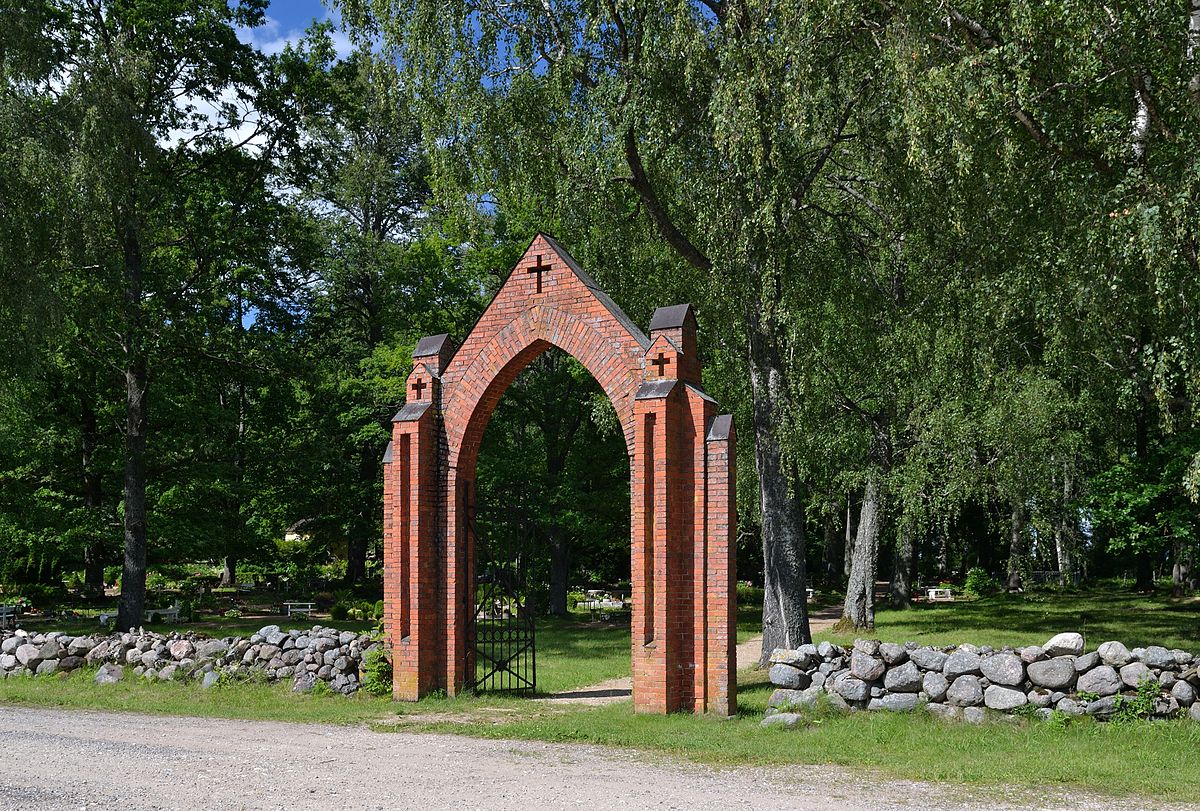
Helgi  then returned to Estonia at long last. Her ashes were buried beside her parents in the Sangaste cemetery. 

Sangaste Cemetery gate and boundary wall
Photograph by Ivar Leidus, from Wikimedia Commons
   

On 27 October 2006, the University of Tartu compensated for Helgi for her lack of formal qualifications by appointing her a Honorary Member.  The University's Institute of Molecular and Cell Biology says, "It is a great honor (sic) for our institute that two persons, who have significantly contributed to the achievement of the statutory goal of the University of Tartu, among other things with significant financial support, have been appointed honorary members of the University of Tartu."
 
I would have thought that Helgi's undergraduate education at that University plus her career as a plant breeder should have been enough to earn her that honour.  However, it is likely that a donation of 3 million Estonian kroons, worth more than $300,000 in Australian currency and probably from her estate, to the Institute would have helped too.

I'm sure the Helgi would have been very pleased by the honour from her alma mater.

I thank Helgi Nirk for sharing her life story.  Her papers are held in the Sydney-based Estonian Archives in Australia.

CITE THIS AS:  Tündern-Smith, Ann (2021) 'Helgi Nirk (1919-2005): Tomato breeder' https://firsttransport.blogspot.com/2021/07/Helgi-Nirk-Tomato-Breeder.html.

REFERENCES

Australian Seed, 'Tomato Burnley Gem, Lycopersicon esculentum', https://www.australianseed.com/shop/item/tomato-burnley-gem/, accessed 5 July 2021. 

'Balt nurses start work', The Herald, Melbourne, 5 January 1948, p 5, https://trove.nla.gov.au/newspaper/article/243852526, accessed 6 July 2021.

Estonian World, 3 September 2020, 'The University of Tartu among the 300 best universities in the world', https://estonianworld.com/knowledge/the-university-of-tartu-among-the-300-best-universities-in-the-world/, accessed 6 July 2021.

Institute of Molecular and Cell Biology, University of Tartu, 'Honorary Doctors, Professors and Associated Professors', https://tymri.ut.ee/en/content/honorary-doctors-professors-and-associated-professors, accessed 23 May 2023.

Nirk, Helgi, 1959, 'Interspecific hybrids of Lycopersicum', Nature 184 pp 1819-20.

Nirk, Helgi, 1972, 'Study tour of tomato breeding institutions', Melbourne, Victoria, Department of Agriculture.

Renaissance Herbs, 'Tomato Burnley Bounty', https://renaissanceherbs.com.au/product/tomato-burnley-bounty/, accessed 5 July 2021. 

The Little Vegie Patch Co 'Tomato, Burnley Surecrop Heirloom Seeds', https://littleveggiepatchco.com.au/collections/tomato-seeds/products/burnley-surecrop-heirloom-seeds-1-1?variant=239173155, accessed 6 July 2021

University of Hohenheim, 11 June 2019, 'Campus', https://www.uni-hohenheim.de/en/campus-en, accessed 6 July 2021.

Vaba Eesti Sõna (Free Estonian Word), 19 February 1987, 'Helgi Nirgi tomat' ('Helgi Nirk's tomato), p 6, complete issue downloaded from https://dea-digar-ee.translate.goog/?a=d&d=vabaeestisona19870219.1.6&e=-------et-25--1--txt-txIN%7CtxTI%7CtxAU%7CtxTA-------------&_x_tr_sl=et&_x_tr_tl=en&_x_tr_hl=en&_x_tr_pto=sc&_x_tr_hist=true 23 May 2023.

Valgamaa kodulooline andmebaas ISIK (Valga County History Database PERSON) 'Nirk, Helgi', https://isik.test.pix.ee/index.php?id=1238, accessed 23 May 2023.

Wikipedia, History of Gdansk, https://en.wikipedia.org/wiki/History_of_Gda%C5%84sk, accessed 6 July 2021.