Updated 1 August 2026.
Back in August last year, we looked at the life of Jonas Motiejūnas, who had been made leader of the Lithuanian men on the First Transport in the Diepholz camp where all had been gathered to await their departure to Australia one week later.
 |
| Jonas Motiejunas' ID photograph from his Bonegilla card Source: National Archives of Australia |
We have also looked at how Borisas Dainutis, chosen by the Lithuanian scouts' organisation in Germany to lead the scouts going to Australia, devoted himself to a campaign of having them recognised as a discrete unit within the Australian scouting movement. That was in July last year.
 |
| Photograph of Borisas Dainutis attached to his selection papers Source: National Archives of Australia |
Now these two themes come together, in an article written by Jonas for a scouting publication in Germany detailing how the scouts organised themselves while on the General Heintzelman and in their first days in Australia. It is in English below, with lots of help from Google Translate and Gemini.ai.
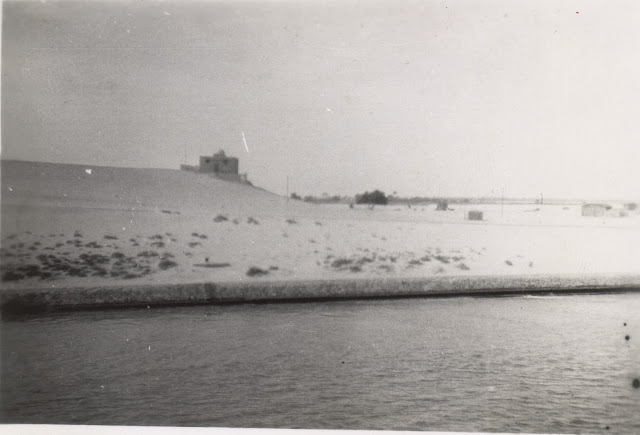
The first meeting of the Lithuanian Scouts going to Australia took place on 9 November 1947, on board our ship, General Stuart Heinzelman, passing through the Suez Canal. The scout authorised to take care of the Lithuanian scouts travelling to Australia, Assistant Section Leader Borisas Dainutis, took over the duties of the leader, choosing Assistant Section Leader Algirdas Liubinskas as his deputy.
%2019490105%20p%2030-3.jpg) |
| Algirdas Liubinskas (left) and Borisas Dainutis at the First Pan-Pacific Scout Jamboree, Yarra Brae, Victoria 1948-49 Source: Weekly Times, Melbourne, 5 January 1949 |
Here, the idea of dividing the scouts into groups was introduced. It also was decided to strictly monitor the behaviour of the scouts and, if necessary, to immediately remove them from scouting, because our task as the first Lithuanian scouts is to represent our homeland and its culture in the best possible way.
On the evening of 10 November, the next meeting took place on the deck of the ship. After reading the orders to the group, its leader reminded everyone in warm words of the tasks of the Lithuanian scouts in Australia. He highlighting the consequences of good behaviour and scouting for our nation and for the future of the country.
Scout and folk songs echoed on the ship and the waves of the Red Sea, uniting the scouts of the new company in close friendship. It was proposed to think about the name of the group and prepare for a bonfire.
On the evening of November 14, on the deck, while the ship was sailing in the Arabian Sea, there was a joint meeting of the younger scouts and senior scouts. In the official proceedings, order No. 3 was followed by a rendition of the anthem, "Lithuanians we were born".
The leader read a long essay by Lord Baden-Powell about the tasks and duties of a Venturer Scout. At intervals, there was singing. On this occasion, the leader once again urged us, in sharp words, to think carefully about remaining in the ranks of the scouts, because the tasks were great and the duties heavy. Participation in the national dance group was clarified and it was asked to prepare performances for the next meeting. Finally, the Vyčiai song (the anthem for the Rover Scouts) was performed.
On 15 November, the management met, with the participation of the Girl Scouts' leader, Konstancija Brundzaitė.
The leaders of the groups were ordered to collect personal information and scouting knowledge from the scouts, to repeat all scout knowledge in the groups and to prepare for a joint public bonfire with the Latvians and Estonians.
After discussion, it was agreed that the Vyčiai (Rover) badge must be worn below the Union badge near the left pocket. The name of the society should express our irrepressible desire to return to the homeland. The meeting was concluded with a minute of silence, remembering our native land and our Vyčiai duties to it.
In the evening of 19 November, a joint meeting of Venturer and Rover scouts was held. Many did not participate. The songs intended to be sung at the joint bonfire were rehearsed.
The long-awaited joint Lithuanian-Latvian-Estonian bonfire was held on the upper deck of the ship on 22 November at 7 pm. All free seats were occupied by passengers interested in the bonfire. The IRO representative, Lithuanian Captain Žibās, and the ship's commander with his team watched the performances from the bridge.
The countless Estonians performed especially beautifully. The Lithuanians were weak, especially in singing, although two-thirds of the participants were from our country. Not enough effort and practice!
I cannot discuss the bonfire program in more detail, because the wind caught hold of my sheet of notes, lifted it to the top of the mast and blew it into the ocean.
The bonfire was led by Lithuanians, Assistant Section Leader Algirdas Liubinskas and Senior Sea Scout Patrol Leader Aleksandras Gabecas.
In Fremantle, on 30 November, in order to get acquainted with the newly arrived scouts, the Australian Sea Scouts’ District Commissioner, Brother Jack, arrived at the Swanbourne camp. There, some of our men had spent a few days of rest after a 10,231 nautical mile (18,948 kilometre) journey. He invited several senior scouts to go and see the Sea Scout headquarters. It was agreed immediately to hold a joint bonfire in the evening.
The Australians liked our program at the previous evening's bonfire so much that they invited us to repeat it during the scout hour on radio on the evening of 1 December. The hastily gathered Lithuanians and Estonians went by train to the radio station. Balanda Dulaityte (already Mrs Liubinskienė, although this was not known to the authorities) explained our origin and arrival in English .
The sailors' march was sung, and Juozas Songaila played a medley of national melodies (on his piano accordion). The Estonians sang several songs. Everywhere we were shown great sincerity.
None of these three Skaudu Aidas articles mention the arrival in Melbourne
but Gabecas' article includes this photograph of Australian Girl Guides
waiting to greet the Lithuanian scouts;
there's at least one equally interesting element in the upper right,
which looks like a young lady in a very short skirt for the times and white boots
In the Bonegilla camp, on 18 December, a Chief Scout representative from Melbourne, another scouting official and a Girl Scout leader came to visit. Having greeted the scouts of all three nationalities who had gathered together with kind words, he was pleased that Australia had received many new scout leaders, whom it lacked. A few songs were sung in the visitors' honour.
Later on 18 December, scouts of the city of Albury visited. Unfortunately, due to the long drought, the danger of bush fires was so great that we had to be content with a kerosene lamp.
Here I should note that in Australia, bushfires are quite frequent and cause very great losses, as entire grain farms, sheep and cattle herds burn, and it is very difficult to fight the fire when everything is completely dry.
Again, there was a singing session. Aleksandras Gabecas performed excellently with a string of bottles tied to a pole and filled with water. The Australian leaders were presented with our scouting publications, and they rewarded us with fruit.
On 4 January 1948, there was another meeting, during which a tracking exercise was conducted.
EDITOR'S NOTE: This story ends abruptly, perhaps due to a decision by the editor of the publication in which it appeared, Skautų Aidas or Scouting Echo, published during 1923-2023 and, in 1947, being edited in a DP camp in Augustdorf bei Detmold, Germany. I thought it might be because the next item, by Jonas Urbonas, might continue the story without a break. It does not. Instead, it is about a campfire on 6 January when the Scouts farewelled their "first swallow", Vytas Kunciunas, who was off to Pyramid Hill.
We've already used some of that article in a biography of Vytas in this blog, when we found it reprinted in Mūsų Pastogė some 50 years later.
What is missing from this sequence is the drowning of Aleksandras Vasiliauskas on 4 January 1948 and his funeral, in which the scouts played a leading role, on 5 January.
NOTE: This is the second item in a series written by Lithuanian Scouts who resettled in Australia. We have not translated the first item, as it is about the voyage to Australia on a later Transport. The second item, on a campfire at Bonegilla in early January was written by Jonas Urbonas and the third, from Aleksandras Gabecas, is about moving to his first job in Tasmania (at Rosebery, about which Jonas Mockūnas has written already.)
CITE THIS AS: Motiejūnas, Jonas (1948) (How the Lithuanian Scouts in Australia Started) Translation and comments from Ann Tündern-Smith with Google Translate and Gemini.au.
SOURCE: Skautų Aidas (Scouting Echo) (1948) 'Įspūdžiai Is Kelionės Australijon, 2. Jau Laive' ('Impressions From a Trip to Australia, 2. Already on Board', in Lithuanian) Augustdorf bei Detmold, Germany, 15 June, p 29 https://www.spauda2.org/skautu_aidas/archive/1948/1948-Nr05-06-SKAUTU-AIDAS.pdf, accessed 17 July 2026.

-2%20edited.tif)
%20edit.tif)